101 Things You Didn't Know about Einstein by Cynthia Phillips & Shana Priwer
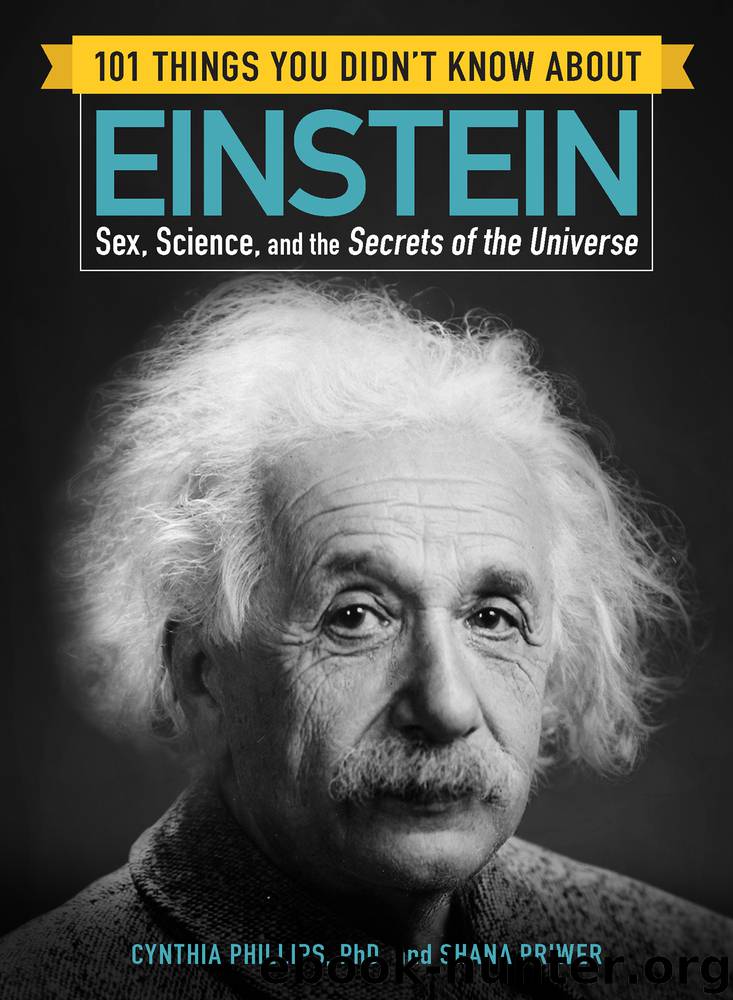
Author:Cynthia Phillips & Shana Priwer
Language: eng
Format: epub
Publisher: Adams Media
51
Einstein’s Formulation of Avogadro’s Number
The last of Einstein’s influential 1905 papers was, in fact, his doctoral dissertation that was submitted for publication in April 1905. This paper was entitled “A New Determination of Molecular Dimensions.” This doctoral dissertation was only seventeen pages long. It was originally rejected for being too short, but Einstein added one sentence and resubmitted it, and it was accepted by his thesis advisor and the Eidgenössische Technische Hochschule (ETH). Bigger isn’t always better.
In this work, Einstein showed how to calculate the sizes of molecules and Avogadro’s number. Out of all Einstein’s papers, this one has been referenced the most by other scientists over the years. Einstein used some experimental results on the diffusion of sugar dissolved in water to calculate the size of sugar molecules. These results suggested that sugar molecules were only about 1 nanometer in diameter (equivalent to 1 billionth of a meter). Einstein’s new results also showed that when sugar was dissolved in water, some of the sugar molecules actually attached themselves to the water molecules. This result was a new one, and it caused the scientific community to take notice.
As part of the research for this paper, Einstein found expressions for the viscosity and the diffusion coefficient for a hard sphere in a continuous medium. Using these expressions and some experimental data based on diluted solutions of sugar in water, he obtained a value for Avogadro’s number that was very close to the currently accepted value.
Avogadro’s number is defined as the number of molecules in a gram-mole of a particular elemental substance. It is named after the chemist Amedeo Avogadro (1776–1856), who first suggested the idea that elements had particular weights; although the term was named in his honor, Avogadro did not actually calculate the value of this number. In fact, the term Avogadro’s number was first used by Jean Baptiste Perrin in 1909 in his paper that followed Einstein’s theoretical result and calculated the size of molecules.
So what is Avogadro’s number good for? Avogadro’s original theory, in 1811, suggested that a particular volume of any gas, at the same temperature and pressure, contained the same number of molecules no matter what gas it was. Experiments were made, and eventually it was concluded that one cubic centimeter of gas contained Avogadro’s number of gas molecules, or about 6 x 10²³ molecules. The current value of Avogadro’s number is actually 6.022 x 10²³, as determined by experiments using x-ray diffraction. Avogadro’s number is very difficult to determine, and many experiments over the years have refined this current value.
Avogadro’s number is also used to define the mole. A mole, in addition to being a small furry mammal, is defined in chemistry as the amount of a substance that contains Avogadro’s number of molecules (or other units). A mole of oxygen contains 6.022 x 10²³ oxygen molecules.
Avogadro’s number can also be used to convert between number and mass. Chemists defined the atomic mass unit (amu) as a relative measurement of mass. Since atoms and molecules
Download
This site does not store any files on its server. We only index and link to content provided by other sites. Please contact the content providers to delete copyright contents if any and email us, we'll remove relevant links or contents immediately.
Hit Refresh by Satya Nadella(9104)
When Breath Becomes Air by Paul Kalanithi(8408)
The Girl Without a Voice by Casey Watson(7870)
A Court of Wings and Ruin by Sarah J. Maas(7785)
Do No Harm Stories of Life, Death and Brain Surgery by Henry Marsh(6923)
Shoe Dog by Phil Knight(5240)
A Higher Loyalty: Truth, Lies, and Leadership by James Comey(4937)
The Rules Do Not Apply by Ariel Levy(4935)
Hunger by Roxane Gay(4909)
Tuesdays with Morrie by Mitch Albom(4753)
Everything Happens for a Reason by Kate Bowler(4722)
The Immortal Life of Henrietta Lacks by Rebecca Skloot(4564)
Millionaire: The Philanderer, Gambler, and Duelist Who Invented Modern Finance by Janet Gleeson(4447)
How to Change Your Mind by Michael Pollan(4338)
All Creatures Great and Small by James Herriot(4294)
The Money Culture by Michael Lewis(4173)
Man and His Symbols by Carl Gustav Jung(4116)
Elon Musk by Ashlee Vance(4108)
Tokyo Vice: An American Reporter on the Police Beat in Japan by Jake Adelstein(3965)
